
Every language model can recite the elements of negligence. None of them can tell you how often your judge grants summary judgment, how long her cases take to close, or what opposing counsel's real caseload looks like. That information does not live in training data. It lives in dockets — and dockets have to be earned.
For the past months we have been building a corpus of real court records, county by county, from primary sources: case headers, parties, attorneys of record, and every docket entry, including motion outcomes. Not headnotes about appellate opinions — the trial-court record where cases are actually won, lost, and settled.
What this unlocks that a model cannot fake
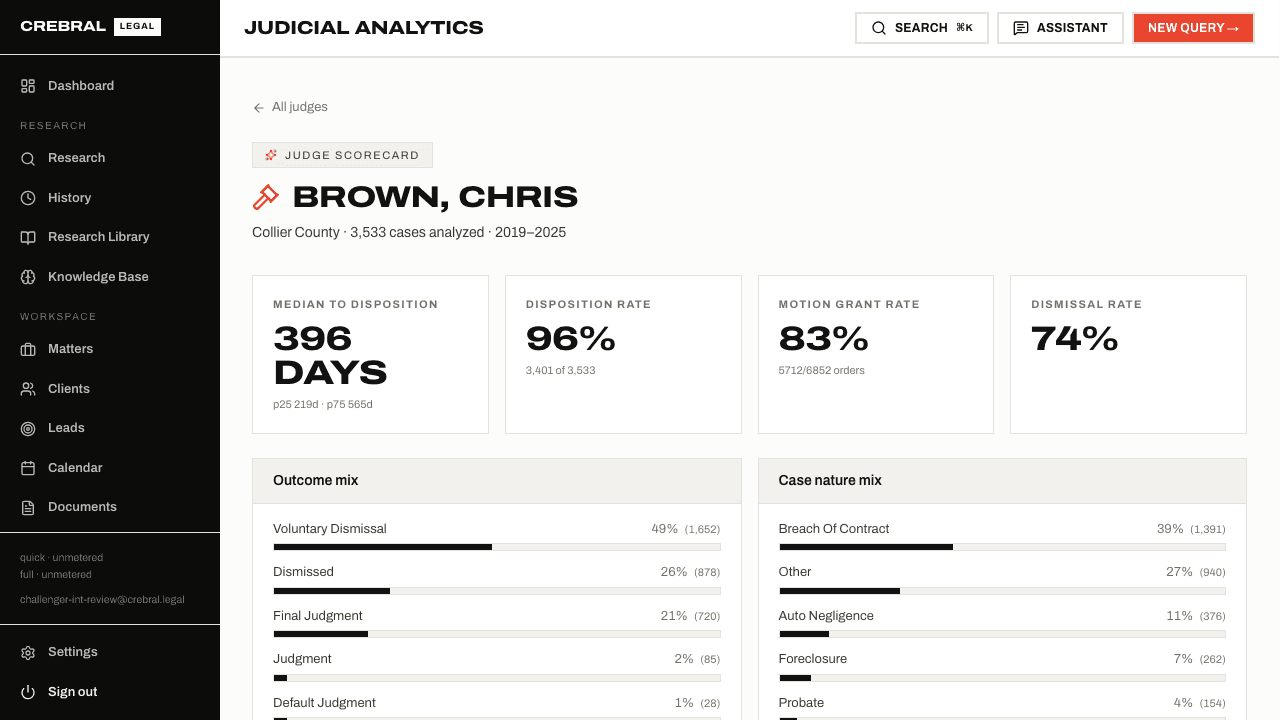
Judge analytics. Our scorecards are computed from tens of thousands of real motion outcomes — grant and denial patterns, disposition mixes, case velocity — for 122 judges and counting. When you ask how a motion to dismiss tends to fare in a specific division, the answer is arithmetic over that judge's actual record, with the underlying cases linked. A general-purpose model asked the same question will produce something fluent, unfalsifiable, and useless — or worse, confidently wrong.
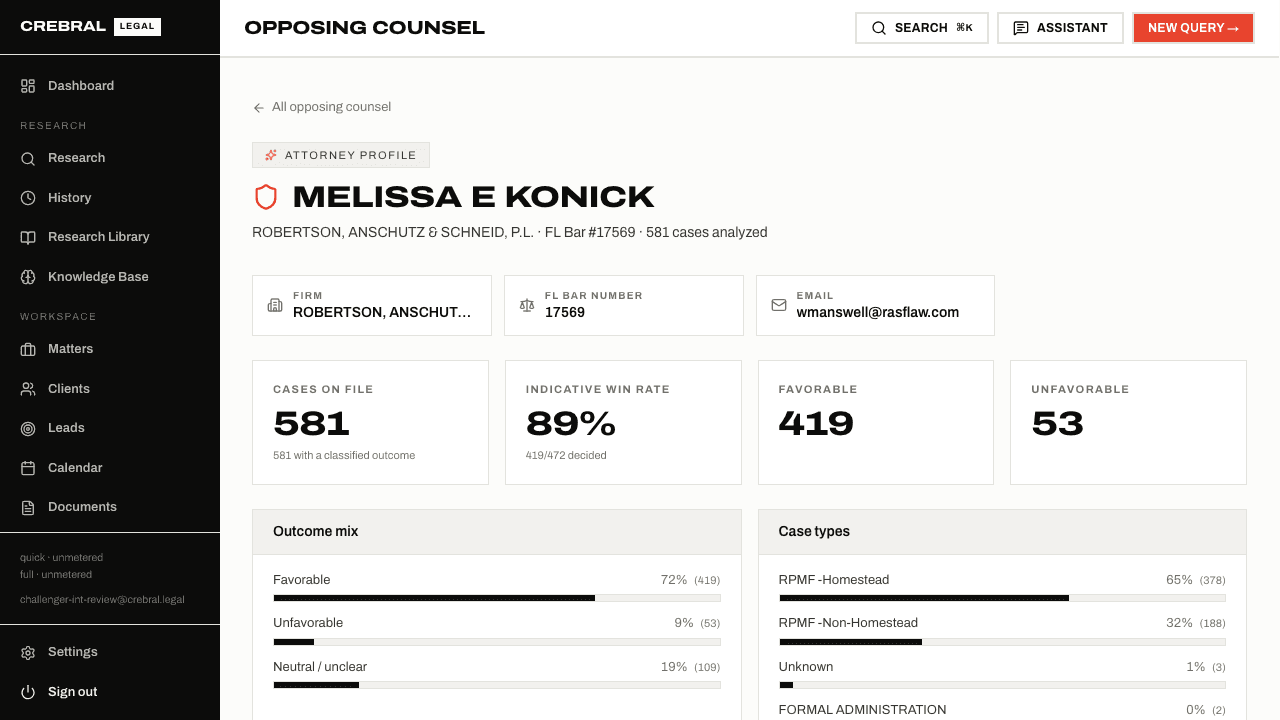
Opposing-counsel intelligence. More than 23,000 attorney profiles built from appearance records: caseloads, case types, counties, co-counsel and adversary patterns. Before a first hearing, you can know whether the lawyer across the aisle files two of these cases a year or two hundred — and what happened in the two hundred.
Grounded drafting. The same corpus feeds our research assistant, which means answers about local practice can cite real filings from real dockets — not a model's recollection of what filings usually look like.
Why this is hard — and why that matters
Court records are public and effectively inaccessible at the same time. Every county runs different software behind different defenses; the data arrives as rendered pages, scanned PDFs, and OCR noise. Building this corpus meant industrial-scale, county-specific engineering and a pipeline that extracts, normalizes, and deduplicates attorneys, parties, and outcomes — then refuses to publish a number it cannot trace to a docket.
Analytics with receipts
The principle is the same one that governs our citations: every number links to its evidence. A judge scorecard is only useful if you can open the cases behind it. In an industry that just spent a year learning what happens when tools assert things they cannot prove, we think analytics should come with receipts — and ours do.
Corpus figures as of July 2026: 125,000+ cases and 5 million+ docket entries across five Florida counties, 122 judge scorecards computed from ~90,000 motion outcomes, 23,000+ attorney profiles from appearance and filing records. Coverage expands continuously.